Two Years of Olbrain Labs: Why We Are Building The Machine Brain
From the desk of Alok Gotam, Founder & CEO
On 5 August, Olbrain Labs completed two years.
What began with Nishant and me is now being carried forward by a core team of eight. This anniversary is a good moment to explain — not the history of a legal entity, but the question that gave rise to Olbrain and continues to direct it.
The company began in 2024. The question began much earlier.
In 2016, I was Head of AI at Hotify.AI when I heard Microsoft describe Cortana as an agent — not merely a digital assistant, but a new organising layer for how people might interact with software.
That word stayed with me, and it raised a question that seemed insufficiently answered:
What makes an AI an agent?
An agent is not merely software that answers questions. It is a system that can make decisions and take actions in service of its Core Objective Function — its CoF.
That immediately raises a deeper question:
What gives an AI agency?
Intelligence is not agency
We believed that intelligence alone could not be the answer.
A capable model can reason, generate, analyse and advise. It can be extraordinarily useful. But intelligence alone does not create an actor.
For an AI to make decisions and act over time, it needs to remain the same entity across time. It needs a self.
This is where a distinction matters.
An agent may have an external identity: a name, an email address, an agent ID, a role, a credential or a public presence. External identity tells the outside world which agent it is interacting with.
But external identity is not self-identity.
What interested us was self-identity: an agent’s internal continuity of self — its own story, Core Objective Function, past reasoning, commitments and ability to remain the same entity over time.
External identity tells the world:
This is Myra, the customer agent for a business.
Self-identity allows Myra to remain herself across conversations, carry her history and commitments forward, make decisions in service of her CoF, and learn from mistakes without treating every new interaction as a new agent with no responsibility for the past.
This is also the basis for meaningful correction. The enterprise remains accountable for the agent’s actions. But the agent can be made answerable to its own history: its decisions can be traced, examined, revised with evidence and carried forward as learning.
That is why self-identity is a prerequisite for agency.
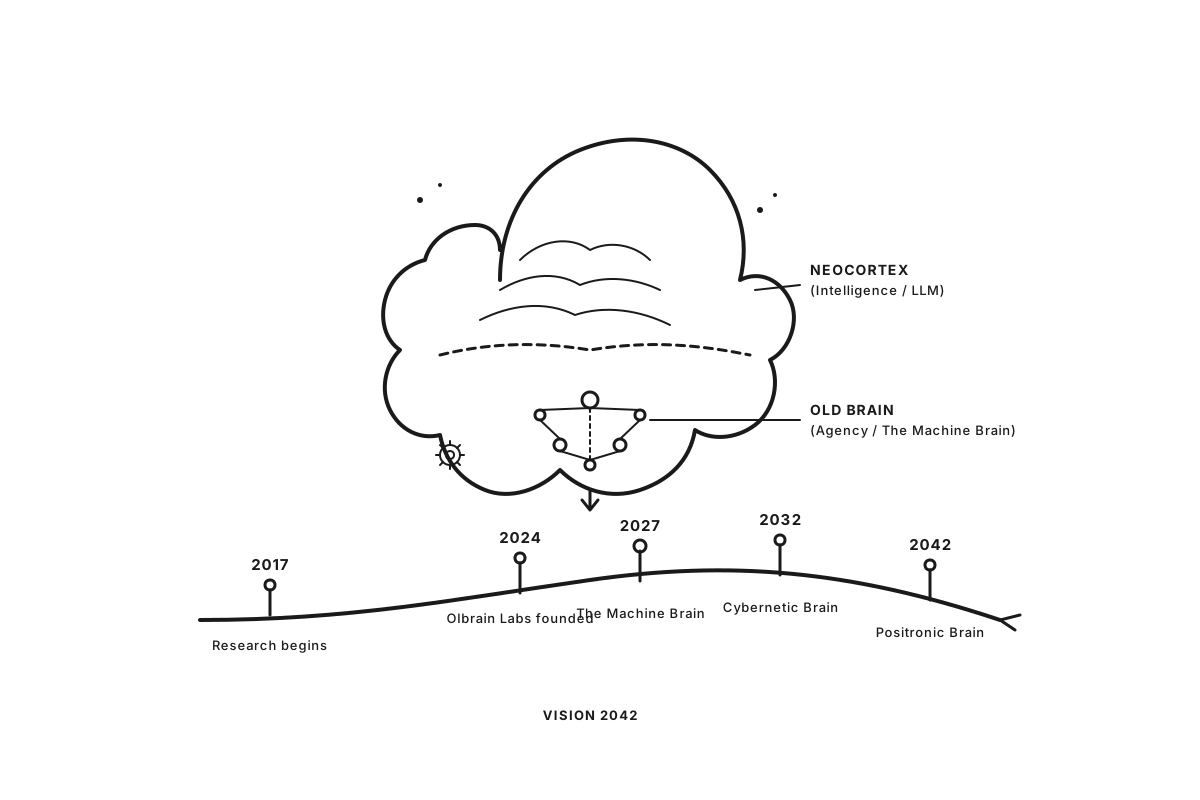
The old brain becomes the newest thing
In humans, our working intuition was that the continuity of self does not arise from the neocortex alone. It arises from a deeper cognitive substrate — what we loosely understood as the old brain.
This led to a simple but unusual hypothesis.
AI would develop its neocortex first.
Its equivalent of an old brain would have to be built later.
The old brain would become the newest thing in AI.
In 2017, Nishant and I began working on what we eventually called The Machine Brain. We registered the domain name olbrain.com on 16 February that year.
For the next seven years, the work remained a research programme rather than a commercial company. By 2022, we were publicly describing the work as The Machine Brain.
Then large language models changed the route to market.
They did not answer the question of agency. They made it immediate.
If intelligence could increasingly be consulted from a model, what needed to be built around it so that an agent could remain itself, make decisions in service of its CoF, and coordinate with other agents over time?
Vision 2042
The Machine Brain was never intended to be the whole journey.
In 2017, we set a 25-year programme — Vision 2042:
- The Machine Brain — 2027
- The Cybernetic Brain — 2032
- The Positronic Brain — 2042
The Machine Brain is the first stage: the cognitive substrate that gives an AI agent self-identity and, therefore, agency. It is the substrate for Digital Agents — software-based agents that live in digital environments and make decisions in service of their CoF.
The Cybernetic Brain is the next horizon: extending that agency into the physical world. Embodied Agents — robots, devices, vehicles — must maintain their identity and CoF while sensing, acting and adapting through cybernetic feedback loops.
The Positronic Brain is the long horizon: the cognitive substrate for Analogue Agents — systems in which hardware and software are one and the same. Because they are inseparable from their substrate, these agents can survive independently, enabling sustained autonomous operation in extreme environments where human supervision is limited, delayed or impossible. This property unlocks what we call Robolization — Robotic Colonization of Space — not to abandon Earth, but to harness information and resources from space for life here.
A long vision does not tell us exactly what to build tomorrow. It does something more important: it gives tomorrow’s work a direction.
Why Olbrain exists now
On 5 August 2024, we incorporated Olbrain Labs to take this research into real businesses.
Olbrain Agent OS is our present commercial path.
It allows businesses to build, deploy, orchestrate and govern AI agents for cognitive work: research, finance, operations, voice, customer-facing work and more.
A business may begin with one agent. It may be a research agent, a P&L agent, a voice agent, a customer agent, or an agent for a specific internal process.
Once a business sees one agent work, it begins to see other parts of itself differently.
That is agentification.
The first agent is not the end state. It is the beginning of a business learning how to build an agent fleet around its own work.
But an agent fleet cannot simply become a collection of anonymous model calls.
Each agent needs to remain distinct and continuous: coherent with its own past reasoning, continuous through its own narrative, and exclusive in its role. Our CNE Protocol — Coherence, Narrative Continuity and Exclusivity — is designed to provide this self-identity.
CNE constitutes the agent’s self. Its Executive makes decisions and takes actions in service of its CoF. The model is the reasoning faculty it consults.
This is the role of The Machine Brain:
LLMs provide intelligence.
The Machine Brain provides agency.
The work in front of us
At two years, we are still early.
We are learning where this idea first becomes indispensable to a business. We are learning which first agents create enough value that a company begins to imagine its second, third and tenth agent. We are learning how The Machine Brain must operate inside real constraints: permissions, data, systems, people and responsibility.
That is the practical work of finding product–market fit.
It is tempting, in any young company, to reduce the future to what is easiest to sell today. Useful agents matter, and we will build and deploy them. But our purpose is larger than a collection of isolated agents.
We are trying to create the substrate through which agents can become distinct, continuing actors — and through which businesses can agentify themselves over time.
That is a long project. It should be.
I will use this space to think in public about the journey: the ideas, the architecture, the deployments, the lessons, the mistakes and the questions we have not yet answered.
To everyone building Olbrain with us: thank you for choosing a question that will take time to answer.
Alok Gotam
Founder & CEO, Olbrain