Vision 2042: The Evolution of Olbrain
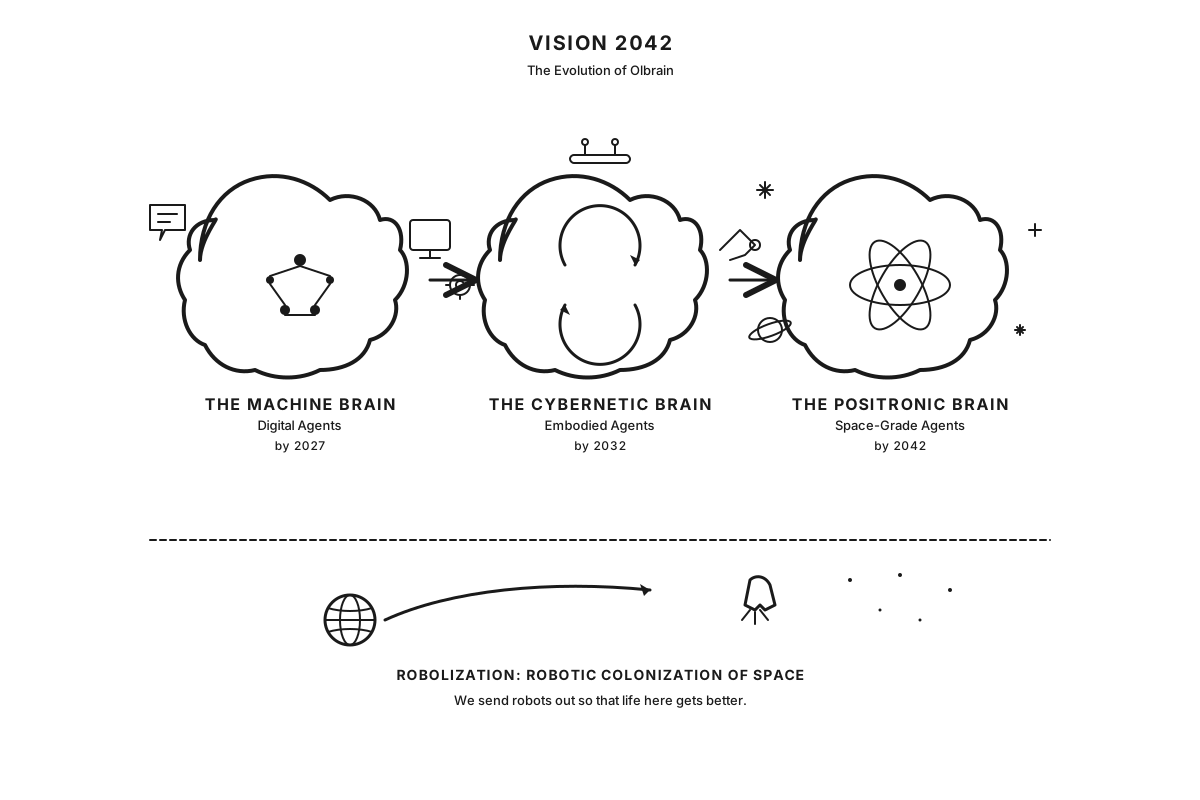
From Digital Agents to Robolization
Today, Nishant and I are beginning work on what we are calling Olbrain — and registering the domain olbrain.com to mark the start.
Olbrain begins with a question:
What gives an AI agency?
An AI can be intelligent without being an agent.
It can answer questions, analyse information, generate content and advise a person. But an agent must do more. An agent must be able to make decisions and take actions in service of its Core Objective Function — its CoF.
For that, intelligence is necessary. But intelligence alone is not sufficient.
An agent also needs a self.
That is the problem we intend Olbrain to address.
We are calling the long-term programme Vision 2042: a multi-decadal path through which Olbrain will evolve from the cognitive substrate for Digital Agents, to the cognitive substrate for Embodied Agents, and eventually to the cognitive substrate for Analogue Agents.
The three stages are:
- The Machine Brain — by 2027
- The Cybernetic Brain — by 2032
- The Positronic Brain — by 2042
The progression is not simply about making AI more intelligent.
It is about extending agency: first into digital environments, then into the physical world, and eventually beyond Earth.
Intelligence and agency are different problems
We expect AI to develop increasingly capable reasoning systems — models that can be consulted for knowledge, analysis, language and planning.
But however capable they become, a reasoning system will not automatically be an agent.
An agent must be able to decide and act over time. It must have a CoF. It must be able to carry context and commitments forward. It must be distinguishable from another agent. And when it makes a mistake, it must be possible to examine what happened, revise its understanding with evidence, and ensure that the learning belongs to that same continuing agent.
This requires identity.
There are two different kinds of identity.
External identity is how the world identifies an agent: its name, email address, agent ID, role, credential or public presence.
Imagine a customer agent — call her Myra — deployed by a business.
External identity tells the world: this is Myra.
That is useful, but it is not enough.
Self-identity is the agent’s internal continuity of self: its own story, CoF, reasoning history, commitments and capacity to remain itself across time.
Self-identity would allow Myra to remain Myra across conversations. It would allow her to carry prior commitments forward, make decisions in service of her CoF, and learn from mistakes without every interaction becoming a new, disconnected response.
The enterprise would remain accountable for what its agents do. But an agent with self-identity could be made answerable to its own history: its decisions could be traced, examined, revised and carried forward as learning.
This is where agency will begin.
We are designing what we call the CNE Protocol — Coherence, Narrative Continuity and Exclusivity — to constitute that self-identity.
Why “The Machine Brain”?
In humans, our working intuition is that the continuity of self does not arise from the neocortex alone.
The neocortex allows us to reason, learn, use language and make sense of the world. But the enduring feeling that I am the same person who made that commitment yesterday seems to depend on a deeper cognitive substrate.
We loosely call that the old brain.
Our hypothesis is that AI will develop its neocortex first. In practical terms, this means increasingly capable reasoning models will arrive before the cognitive substrate that gives an AI a continuing self and agency.
The old brain will become the newest thing in AI.
That is why we call it The Machine Brain.
The Machine Brain will not be a model. It will be the cognitive substrate through which an AI agent can have self-identity and therefore agency.
V1.0: The Machine Brain — by 2027
The first stage of Vision 2042 is The Machine Brain.
By 2027, Olbrain aims to become the cognitive substrate for Digital Agents.
Digital Agents will be software-based agents that live in digital environments: messaging platforms, websites, applications, enterprise systems and other software interfaces. They will represent a business to its customers, assist internal teams, conduct research, manage workflows, analyse financial data or operate within approved systems.
They will not be defined by the channel on which they appear. They will be defined by their capacity to make decisions and take actions in service of their CoF.
A customer-facing agent might live across multiple channels — messaging, a website and an app. The customer should not experience three disconnected bots. They should experience the same agent, with the same identity, history and commitments.
An internal agent might help a finance team prepare a P&L projection, assist a consultant with research, qualify leads, conduct voice conversations or operate an approved workflow. It too would need to remain coherent with its own history and purpose.
This is the work we intend to build.
We envision a platform — Olbrain Studio — that will enable businesses to build, deploy, orchestrate and govern agent fleets. A business might begin with one agent for one meaningful cognitive task. Once it experiences that agent in practice, it will begin to identify the next task, the next agent and eventually the larger opportunity to agentify itself.
The Machine Brain will be the substrate beneath this process.
Its role will be to ensure that a Digital Agent is more than an anonymous model call. It will give the agent a continuing self that can remain coherent with its prior reasoning, persist through its narrative, and be exclusive in its role.
V2.0: The Cybernetic Brain — by 2032
The second stage is The Cybernetic Brain.
By 2032, Olbrain aims to extend from Digital Agents to Embodied Agents.
Embodied Agents inhabit physical bodies: robots, devices, vehicles and other machines that sense and act in the real world.
This is a fundamental expansion of the problem.
A Digital Agent acts through software interfaces. An Embodied Agent must act through the physical world. It must receive signals from an environment, interpret those signals, decide what to do, act through a body or device, observe the outcome and adapt.
That is a cybernetic loop:
sense → interpret → decide → act → receive feedback → learn
But a feedback loop alone does not make an enduring agent.
The Cybernetic Brain will extend the foundation of The Machine Brain into the physical world. The agent will need to maintain its identity and CoF while interacting with changing environments, imperfect information, physical consequences and other agents.
The question becomes:
How can an embodied agent adapt to the world without losing itself?
This is why The Cybernetic Brain is not simply a robotics programme. It is a programme for embodied agency.
V3.0: The Positronic Brain — by 2042
The third stage is The Positronic Brain.
By 2042, Olbrain aims to become the cognitive substrate for Analogue Agents.
We use “analogue” here to describe systems in which hardware and software are one and the same — inseparable. This is the core property of analogue systems: you cannot differentiate between the substrate and the intelligence it carries. Unlike digital or cybernetic agents, an analogue agent’s identity cannot be copied, transferred, or migrated to another machine. It is bound to its substrate.
The benefit of this inseparability is independence. Because these agents do not depend on external infrastructure for their cognition, they can survive and operate autonomously over very long durations.
Space is the ultimate environment that demands this independence. Analogue agents must operate through uncertainty, distance, delay, resource constraints and conditions that make continuous human supervision impractical. They must remain coherent over long durations, preserve their identity, continue learning and act in service of an objective even when Earth is far away.
The Positronic Brain is therefore the long-horizon ambition of Vision 2042: a cognitive substrate for analogue agents that will be capable of sustained, independent operation — including beyond Earth.
Robolization: Robotic Colonization of Space
The ultimate purpose of building The Positronic Brain is Robolization: Robotic Colonization of Space.
The phrase requires an important distinction.
Robolization is not intended to pave the way for human colonisation of space.
It is not an escape plan from Earth.
And it is not based on the idea that humanity should abandon its home planet.
The purpose is to harness information and resources from space for life on Earth.
We send robots out so that life here gets better — not so that we abandon it.
A future in which agents can operate beyond Earth could enable exploration, resource discovery, scientific understanding and forms of ecological or material capability that are unavailable to us today. The ultimate value of that work should return to life on this planet.
That is the purpose of Robolization.
A roadmap, not a claim that the work is finished
Vision 2042 is not a claim that the future has already been solved.
It is a direction.
The practical work will begin with The Machine Brain: Digital Agents that can operate in real businesses with a continuing self-identity, a clear CoF, governed permissions and a history from which they can learn.
The next steps will require advances in embodiment, control, feedback, robotics, long-duration operation and our understanding of machine self-identity.
The final horizon will require breakthroughs that no company can honestly claim today.
But long-term work needs a long-term direction.
The Machine Brain will give agents self-identity and agency.
The Cybernetic Brain will extend that agency into physical environments.
The Positronic Brain will extend it into the most demanding environments we can imagine.
That is Vision 2042.
Models will provide intelligence.
The Machine Brain will provide agency.